Validate your child's feelings

But that isn't how the newer child behavior books and videos are using it. They validate not just the experience but the perception of the experience. They validate in the literal sense of the word instead of the resultant of their emotional welfare and experience.
That’s weird to me. I wasn’t aware of this.
 
@TerryHauck—

This topic interests me. If you’re open to it, I’d like to explore it a bit more with you.

Comparing and contrasting the two paradigms concerning this idea of validation is meaningful to me.

For one, it’s giving me a chance to find words for my approach to certain key aspects of parenting.

Understanding other view points on parenting is always meaningful to me, as well.

Identifying common ground of various perspectives can also be fruitful for various reasons.

After our interchange on this yesterday, I realized it would be helpful if I had a clearer understanding of both paradigms.

I do read things about parenting occasionally, but I realize I largely parent intuitively in accordance with a specific sensibility and set of principles that ring true to me in so far as their wisdom, effectiveness, and their ability to instill the values and outlook I hope to foster in my children, cleanly, and with heart. But I’m not out there consuming books or videos on stuff like this, so I’m not necessarily up on all the current parenting trends or assertions of behavioral psychology. I have educated myself on developmental psychology, but that was years ago—scientific consensus may have changed since then.

So, I looked into the two paradigms a bit.

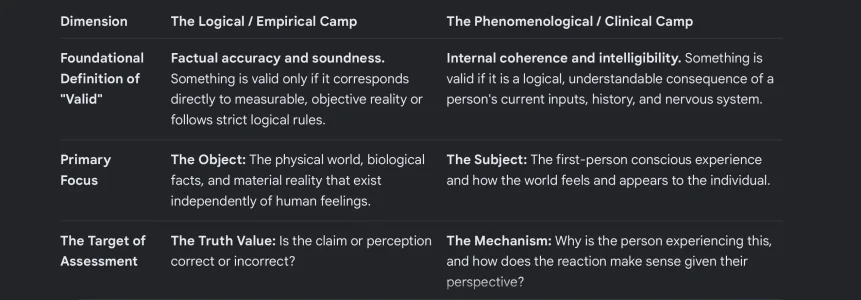
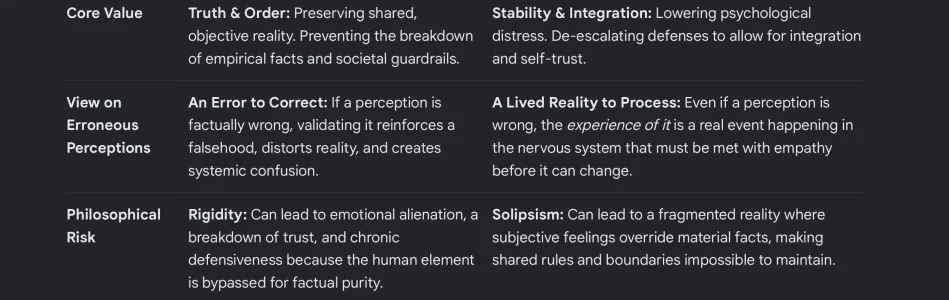
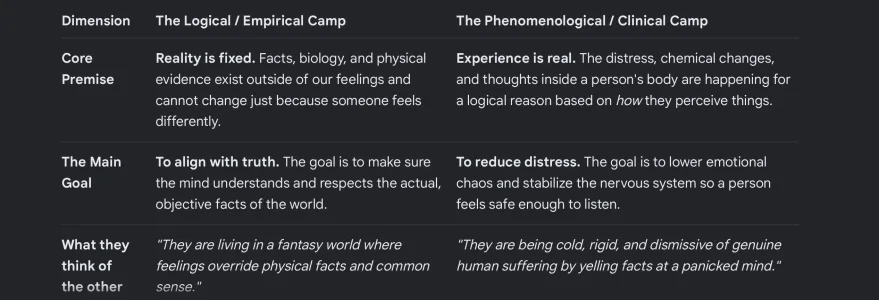
I feel that it would very helpful moving forward for us to agree upon exactly what each of these camps actual espouse. So, below I have included an AI summary I found.

Does this feel like a fair and accurate summary of the two main camps as you see it?

IMG_0768.webp
IMG_0769.webp IMG_0770.webp

Also, I’m curious about your context in talking about this. If you don’t mind, I think it could also be helpful if you could fill some of that in for me.

Are you married? Do you have children? If so, how many and what are their ages? Boy(s), girls(s), maybe one(or more) of each? If you do have children do you and their mother share the same philosophy on this topic? Do you have any academic background that you would say informs any of this for you?—perhaps a degree in psychology, education, theology, philosophy (or something else).

As for me, my wife and I have two daughters. Sylvie will be 6 this coming March, and Ember will be 4 in November. I have a degree in radiologic sciences, and what informs my perspective is largely that I’m passionate about fathering and depth psychology, and that my cognitive stack is respectively, Ni, Fe, Ti, Se.

Cheers,

Erik
 
Last edited:
@TerryHauck—

This topic interests me. If you’re open to it, I’d like to explore it a bit more with you.

Comparing and contrasting the two paradigms concerning this idea of validation is meaningful to me.

For one, it’s giving me a chance to find words for my approach to certain key aspects of parenting.

Understanding other view points on parenting is always meaningful to me, as well.

Identifying common ground of various perspectives can also be fruitful for various reasons.

After our interchange on this yesterday, I realized it would be helpful if I had a clearer understanding of both paradigms.

I do read things about parenting occasionally, but I realize I largely parent intuitively in accordance with a specific sensibility and set of principles that ring true to me in so far as their wisdom, effectiveness, and their ability to instill the values and outlook I hope to foster in my children, cleanly, and with heart. But I’m not out there consuming books or videos on stuff like this, so I’m not necessarily up on all the current parenting trends or assertions of behavioral psychology.

So, I looked into the two paradigms a bit.

I feel that it would very helpful moving forward for us to agree upon exactly what each of these camps actual espouse. So, below I have included an AI summary of this.

Does this feel like a fair and accurate summary of the two main camps as you see it?

View attachment 103666
View attachment 103667View attachment 103668

Also, I’m curious about your context in talking about this. If you don’t mind, I think it could also be helpful if you could fill some of that in for me.

Are you married? Do you have children? If so, how many and what are their ages? Boy(s), girls(s), maybe one(or more) of each? If you do have children do you and their mother share the same philosophy on this topic? Do you have any academic background that you would say informs any of this for you?—perhaps a degree in psychology, education, theology, philosophy (or something else).

As for me, my wife and I have two daughters. Sylvie will be 6 this coming March, and Ember will be 4 in November. I have a degree in radiologic sciences, and what informs my perspective is largely that I’m passionate about fathering and human psychology, and that my cognitive stack is respectively, Ni, Fe, Ti, Se.

Cheers,

Erik

This deserves more thought but I will start here by filling in some of the information before I go further in a another post after some pondering.


I have a wife nearly 20 years married and a daughter who is three. I don't have any other children.


I think I see validity in both camps. However in my experience and my growth I find myself naturally sitting in the left side trying to adopt the value of the second. IE there are traps in the thinking of both.

The first seems like the Thinking side, the trap is thinking your thoughts are truth and objective reality. This is a trap because, it is impossible, and going beyond alignment with reality and falsely coorelating your understanding as the same as reality means you are no longer open to alternative perspectives, and alternative experiences. Essentially tunnel vision.


The Feeling side is open to perspectives and experiences more easily. It's trap is a little different. The trap is not aligning yourself with reality and instead trying to align reality to your feeling of it. This makes your experience the truth regardless of the truth founding that experience. In extreme, it can start to discount others experiences when in conflict. My experience is more valid than yours.

Both have different traps but find themselves isolated in their understanding of reality and from others experience of reality.

I think there is value of recognizing which you are in and reaching across to find value in the other side and applying it.


However as far as this fits with my earlier statement of authentic relationship with reality. I think I just mean honestly persuing reality, not saying that this is or is not reality but to recognize the value of alignment and to find ways to pursue that.

I don't think everyone has that inclination because it can be destabilizing at first when you start with your own. It's certainly easier to discount someone else. But I thi k that isn't the point. The point is to align ourselves together and find where truth is shared between us and how it fits in objective reality. Not to discount other people's experiences.
 
Right on.

Thanks for filling that in and for shitting more light on your perspective. That actually expands things quite a bit.

But to be clear, do you agree that the AI summary above is a fair and accurate representation of those two paradigms?

(Not to be obtuse, but I’m looking for a yes or no answer, so that we can clearly move forward.)
 
Last edited:
Right on.


Thanks for filling that in and for shitting more light on your perspective. That actually expands things quite a bit.


But to be clear, do you agree that the AI summary above is a fair and accurate representation of those two paradigms?


(Not to be obtuse, but I’m looking for a yes or no answer, so that we can clearly move forward.)

I will add that I have no background other than interest. I am INTP and the testing is usually strongly represented that way. I just noticed I missed addressing those questions...

It isn't an accurate summary of the original post I was making in regards to validation, if that is what you mean. But I can see this existing in certain perspectives or more accurately the general population of people.

What I was talking about was more of a niche' of child parenting help books and when I read and listened to videos. As part of adopting it was pushed very strongly and I was excited to engage, but some use the term 'validation' but in practice they acknowledge the feelings and try to understand them. The other thing I run into is the videos that try to validate in the stronger sense.

IE
Clinical Validation: I see that you are angry but we don't hit.

Some Books and Videos: Its okay to be angry but we don't hit.

Most people probably don't see these as different. But it's a clear difference to how these two cmps use these words.

In a clinical sense, as I understand it, there is no judgment on whether it's okay to be angry or not. It simply is a fact of one's experience, but it is an experience we should acknowledge and try to understand. And if the experience holds, valid afterwards then we, or more so they can judge the experience afterwards.

In a child's mind, "if anger is okay, does that mean it can be not-okay? "

VS

"It is significant and worth acknowledging but it isn't bad and isn't good, what do I do with it?"

Seems worth pondering.
 
Last edited:
You just wrote a lot of things worthwhile to discuss. I’d like to return to them.

But for the sake of clarity…

It isn't an accurate summary of the original post I was making in regards to validation, if that is what you mean. But I can see this existing in certain perspectives or more accurately the general population of people.

No, that is not what I meant. The question I was asking was, do you think the AI summary above is objectively accurate and fair to the two camps themselves?

I think there is a spectrum between them and you have basicly said you are not strictly polarized. Neither am I.

In order for us to discuss where how we individually actually see the subject—and you have done a really good job explaining your perspective, whereas I am trying to establish a reference point from which to explain mine—an agreed upon definition of how either camps views the topic is really helpful.

I don’t feel you answered the question I was asking.

So, I’m reaching here, but it’s because this is what you have given me to work with:

“It isn't an accurate summary of the original post I was making in regards to validation”.

I am going to take it as a “no”.

If that’s the case, then I propose we find agreement on what the camps actually are.

Then, we can better determine where you and I lie on the spectrum, no?
 
@TerryHauck—

So here again is another AI summary of the two camps. Do you agree, yes or no, that these are fair and accurate representations of the stances of those two camps?

IMG_0771.webp

I understand you don’t fall cleanly into either, Terry.
 
You just wrote a lot of things worthwhile to discuss. I’d like to return to them.

But for the sake of clarity…


No, that is not what I meant. The question I was asking was, do you think the AI summary above is objectively accurate and fair to the two camps themselves?

I think there is a spectrum between them and you have basicly said you are not strictly polarized. Neither am I.

In order for us to discuss where how we individually actually see the subject—and you have done a really good job explaining your perspective, whereas I am trying to establish a reference point from which to explain mine—an agreed upon definition of how either camps views the topic is really helpful.

I don’t feel you answered the question I was asking.

So, I’m reaching here, but it’s because this is what you have given me to work with:

“It isn't an accurate summary of the original post I was making in regards to validation”.

I am going to take it as a “no”.

If that’s the case, then I propose we find agreement on what the camps actually are.

Then, we can better determine where you and I lie on the spectrum, no?

Yes, it is an accurate description of two camps pertaining to the general population.

The one issue I have is the "target of assessment" . One cannot be assessed with the other.
How can we determine is something is valid or correct without considering the perspective of the other person?

Then it depends on the situation. Or am I missing the context in which this is applied?
 
@TerryHauck—

So here again is another AI summary of the two camps. Do you agree, yes or no, that these are fair and accurate representations of the stances of those two camps?

View attachment 103669

I understand you don’t fall cleanly into either, Terry.

I think this is describing a very different thing than the previous one.

Before i could break the left side and the right side by two value systems

Objectivety vs Subjectivity

Now it's

Shifted to
Objectivety vs Avoidance? (Avoid bad emotions)
 
Yes, it is an accurate description of two camps pertaining to the general population.

The one issue I have is the "target of assessment" . One cannot be assessed with the other.
How can we determine is something is valid or correct without considering the perspective of the other person?

Then it depends on the situation. Or am I missing the context in which this is applied?
Excellent. Now we’re cooking.

I thought that might be something you would tune into. I did a double take too.

IMG_0768.webp

My take is that the first camp will first define what the child’s perspective is and then focuses on wether the child’s perception is objectively correct or incorrect.

Then my take is that the second camp defines what what the child’s perspective is and then focuses on why they see it that way and how their reaction makes sense given how they see it.
 
I think this is describing a very different thing than the previous one.

Before i could break the left side and the right side by two value systems

Objectivety vs Subjectivity

Now it's

Shifted to
Objectivety vs Avoidance? (Avoid bad emotions)
Maybe that’s part of how that camp see things? I don’t know. That’s exactly why I’m going here. I wanna get a grip on them. Perhaps they are slippery?
 
Excellent. Now we’re cooking.

I thought that might be something you would tune into. I did a double take too.

View attachment 103670

My take is that the first camp will first define what the child’s perspective is and then focuses on wether the child’s perception is objectively correct or incorrect.

Then my take is that the second camp defines what what the child’s perspective is and then focuses on why they see it that way and how their reaction makes sense given how they see it.

This feels better but I need to test more. I think we need to see what this looks like in practice or we might think we are the same page but then walk past each other. Is there an example of these two things that you feel fits what you are trying to describe?
 
Ok, this is a good spring board.

I’m not the best at comping up with examples. If you can come up with a sittuation for us to work with, I can try to relate it to how I think the two camps might handle it, as I understand it. Then I can try to describe how I would handle it and you can do the same?
 
Last edited:
Taking what you came up with I did some pondering and after trying to make work with everything I had to add more categories to get a better picture. I think this fits but I need help with any adjustment or if it's completely off just let me know...

I don't think a person fits in a specific category specifically, but does have tendencies towards one and can shift between them when higher priorities shift the spectrum.

.

Four Tendencies​

Non-HolisticHolistic
ObjectiveObjectivity

Objective reality is the focus
; the child's perspective may be considered insofar as it helps understand the situation.
Objective + Holistic

Objective reality remains primary
, but everyone's experience and perspective are deliberately brought into consideration.
SubjectiveSubjectivity

The child's lived experience is the focus
; objective reality may not be on the radar.
Subjective + Holistic

Experience remains primary
, but objective reality and everyone's experience and perspective are deliberately brought into consideration.

​

EXAMPLES


Situation​
Objectivity​
Objective + Holistic​
Subjective + Holistic​
Subjectivity​
Leaving the playground — After a Five Minute Notice“It's time to leave. If you don't come, I'll carry you.”“I know you really want to keep playing. It's time to leave, but you can walk to the car or I can carry you. We can play again tomorrow.”“We were having fun but it’s time to go. Let's head home and play with your blocks together.”“You’re having so much fun. You can have five more minutes.”
Won't wear a coat“It's cold outside. You need your coat. If you don't put it on, I'll put it on you.”“I know you don't want to wear it, but you will probably get cold. How about you leave it unzipped and you can zip it up if you get cold? You can also take it off in the car.”“I know you don't want to wear it. Let's take it with us, and if you get cold you can put it on.”“You don't like wearing your coat, and that's okay. You don't have to wear it. I'll keep it in the car if you need it.”
Afraid of the dark“You don’t need to be afraid of the dark. Go back to sleep.”“You don’t need to be afraid, but I will turn on a nightlight or leave the door open if that helps.”“Oh, the dark is scary. I can stay with you for a bit, and we can leave the door open. We'll make your room feel comfortable.”“It’s okay to be scared. You can sleep in our bed tonight.”
Wants another bedtime story“We've already read five stories. It's time for bed.”“I know you want to read another story, but we read five, so it's time for bed. We will read more tomorrow.”“Stories are a lot of fun, but we read five. How about we turn out the lights and rest while we talk about your day?”“Stories are a lot of fun. Let's read another one.”
Doesn't want to clean up“The toys need to be cleaned up. Start putting them away.”“The toys need to be put away. I'll help you, and you can choose which ones we put away first.”“You don't want to clean up right now. Let's put these away together, then we can do something you enjoy.”“It’s okay if you’re still having fun. We can clean up when you’re ready.”
Doesn't want to leave a friend's house“It's time to go. Get your shoes.”“I know you want to stay, but it's time to go. You can say goodbye, and we'll come back another day.”“I know you want to stay. Let's say goodbye, and we can plan another time to play together.”“It's nice to spend time with your friend. You can stay a little longer.”
Wants to play instead of eating dinner“Dinner is ready. Come to the table.”“I know you'd rather keep playing, but dinner is ready. You can leave it for after dinner.”“I know you'd rather keep playing. Finish what you're doing, then we'll eat together.”“Playing is more fun right now. You can finish playing before dinner.”
Doesn't want to apologize after hitting“You don’t hit. You need to apologize.”“Go tell them you should not have hit them. Then tell them you're sorry.”“Let's check on them and see if they are okay. Then you can tell them you're sorry.”“It’s okay to be angry, but we shouldn’t hit our friends. ”


Note: These are tendencies, not fixed categories. A person may scale toward different approaches depending on the situation and its priorities. Rigid adherence to any one tendency is recognized as impractical and emotionally intolerable.

Examples of shifting criteria:


  • Safety concerns: Tend toward Objective and greater rigidity; immediate safety can outweigh the child's emotional experience.
  • Emotional dysregulation: Tend toward Subjective + Holistic; prioritize helping the child regulate and improving their immediate experience without necessarily changing the underlying boundary.
  • Parental fatigue: Can shortcut deliberate adjustment toward the parent's natural response pattern. This may manifest as extreme Subjectivity, using accommodation or avoidance to reduce immediate conflict, or extreme Objectivity, using rigid rules or control to quickly establish order.
 
Yes, I’d say this is a very decent way to categorize the different approaches you see parents tending towards.

I don't think a person fits in a specific category specifically, but does have tendencies towards one and can shift between them when higher priorities shift the spectrum.

My sensibility as a dad would tend to fall into the “objective + holistic” arena, but as you said, it will sometimes shift one way or the other on the spectrum as my judgement sees fit given what priorities are pressing.

We have established some things that you and I have differing opinions on earlier in the thread, but I gather that the “objective + holistic” category is where you would place yourself on the spectrum of parenting tendencies on this subject matter as well, yes?
 
Yes, I’d say this is a very decent way to categorize the different approaches you see parents tending towards.


My sensibility as a dad would tend to fall into the “objective + holistic” arena, but as you said, it will sometimes shift one way or the other on the spectrum as my judgement sees fit given what priorities are pressing.

We have established some things that you and I have differing opinions on earlier in the thread, but I gather that the “objective + holistic” category is where you would place yourself on the spectrum of parenting tendencies on this subject matter as well, yes?


Yes, I am naturally objective holistic but trend objective under stress and try to move towards subjective-holistic when my daughter is needing more emotional support IE emotional dysregulation. I imagine if confidence becomes a problem for her, I would also move more towards subjective but at three identity is more lived then questioned.
 

This to me resembles more how adults tend to interact than parents and children.

The tendency to be one way or the other I have seen this in many people.

So like when I deal with the "logical" type people they tend to be very set in what is real and what is not real.

The phenomenological set of people have more dysregulation so I must tip toe around in what I say.

So it is hard to get either to agree with certain basic assumptions that would lead to mutual understanding.

It is like you must agree in total with what they happen to view as true otherwise you are "daft" or "mean" and nothing else.

Children may act this way because of some developmental features in them where they cannot follow logic but also when they do follow logic it is rigid and cannot be any way other that the logic they know.

At some level the adult must understand that children are not fully developed but this does not eliminate the fact that not all adults can be as flexible as we would suppose they are supposed to be. This lack of flexibility can make people quit agitated when disagreed with.

It also makes people have a black and white mentality that unless you agree with me you are against me. Once people see another person as against them they will fight them no matter what they actually believe or what the actual views that person has are and hold to be.

So it is not just that two camps exist that will be against each other as one would be superior to the other but actually they show that rigidity and emotional problems go hand in hand but in different ways. We each have our own set of "logic" we follow to some degree how we understand language but then if the emotions come into play we would not allow others to disagree no matter how logical or illogical.

This is a bias people may have depending on how invested they are in certain ideas or views or beliefs or anything they hold above reproach. When reasoning with children it is easier to see what is wrong and correct that kind of cognitive bias, in adults not so much.

So camps is not a good way of looking at the situation because this will inevitably make people fight. What is is better rather is looking at what can fix problems.

If one wishes to fix problems logical, emotional or anything else the best thing to do is be mature and accommodate to what the person you are interacting with is like psychologically and personally. Otherwise you are making the person see you as against them which is never beneficial to anyone.

With children I agree we need to identify the emotion non-judgmentally and see what we can do constructively to everyone's benefit.

It is not so much we need to correct them as understand ourselves the situations children face to alleviate problems detrimental to development.
 
So camps is not a good way of looking at the situation because this will inevitably make people fight. What is is better rather is looking at what can fix problems.
For sure, Brother, just a means to an end. Starting with two polarities concerning this validation thing so we could get to talking about what lies in between. Never so simple. Check out Terry’s above chart. Now we are onto 4 categories filling in the middle

Some good points you have.
 
Last edited:
Taking what you came up with I did some pondering and after trying to make work with everything I had to add more categories to get a better picture. I think this fits but I need help with any adjustment or if it's completely off just let me know...

I don't think a person fits in a specific category specifically, but does have tendencies towards one and can shift between them when higher priorities shift the spectrum.

.

Four Tendencies​

Non-HolisticHolistic
ObjectiveObjectivity

Objective reality is the focus
; the child's perspective may be considered insofar as it helps understand the situation.
Objective + Holistic

Objective reality remains primary
, but everyone's experience and perspective are deliberately brought into consideration.
SubjectiveSubjectivity

The child's lived experience is the focus
; objective reality may not be on the radar.
Subjective + Holistic

Experience remains primary
, but objective reality and everyone's experience and perspective are deliberately brought into consideration.

​

EXAMPLES


Situation​
Objectivity​
Objective + Holistic​
Subjective + Holistic​
Subjectivity​
Leaving the playground — After a Five Minute Notice“It's time to leave. If you don't come, I'll carry you.”“I know you really want to keep playing. It's time to leave, but you can walk to the car or I can carry you. We can play again tomorrow.”“We were having fun but it’s time to go. Let's head home and play with your blocks together.”“You’re having so much fun. You can have five more minutes.”
Won't wear a coat“It's cold outside. You need your coat. If you don't put it on, I'll put it on you.”“I know you don't want to wear it, but you will probably get cold. How about you leave it unzipped and you can zip it up if you get cold? You can also take it off in the car.”“I know you don't want to wear it. Let's take it with us, and if you get cold you can put it on.”“You don't like wearing your coat, and that's okay. You don't have to wear it. I'll keep it in the car if you need it.”
Afraid of the dark“You don’t need to be afraid of the dark. Go back to sleep.”“You don’t need to be afraid, but I will turn on a nightlight or leave the door open if that helps.”“Oh, the dark is scary. I can stay with you for a bit, and we can leave the door open. We'll make your room feel comfortable.”“It’s okay to be scared. You can sleep in our bed tonight.”
Wants another bedtime story“We've already read five stories. It's time for bed.”“I know you want to read another story, but we read five, so it's time for bed. We will read more tomorrow.”“Stories are a lot of fun, but we read five. How about we turn out the lights and rest while we talk about your day?”“Stories are a lot of fun. Let's read another one.”
Doesn't want to clean up“The toys need to be cleaned up. Start putting them away.”“The toys need to be put away. I'll help you, and you can choose which ones we put away first.”“You don't want to clean up right now. Let's put these away together, then we can do something you enjoy.”“It’s okay if you’re still having fun. We can clean up when you’re ready.”
Doesn't want to leave a friend's house“It's time to go. Get your shoes.”“I know you want to stay, but it's time to go. You can say goodbye, and we'll come back another day.”“I know you want to stay. Let's say goodbye, and we can plan another time to play together.”“It's nice to spend time with your friend. You can stay a little longer.”
Wants to play instead of eating dinner“Dinner is ready. Come to the table.”“I know you'd rather keep playing, but dinner is ready. You can leave it for after dinner.”“I know you'd rather keep playing. Finish what you're doing, then we'll eat together.”“Playing is more fun right now. You can finish playing before dinner.”
Doesn't want to apologize after hitting“You don’t hit. You need to apologize.”“Go tell them you should not have hit them. Then tell them you're sorry.”“Let's check on them and see if they are okay. Then you can tell them you're sorry.”“It’s okay to be angry, but we shouldn’t hit our friends. ”


Note: These are tendencies, not fixed categories. A person may scale toward different approaches depending on the situation and its priorities. Rigid adherence to any one tendency is recognized as impractical and emotionally intolerable.

Examples of shifting criteria:


  • Safety concerns: Tend toward Objective and greater rigidity; immediate safety can outweigh the child's emotional experience.
  • Emotional dysregulation: Tend toward Subjective + Holistic; prioritize helping the child regulate and improving their immediate experience without necessarily changing the underlying boundary.
  • Parental fatigue: Can shortcut deliberate adjustment toward the parent's natural response pattern. This may manifest as extreme Subjectivity, using accommodation or avoidance to reduce immediate conflict, or extreme Objectivity, using rigid rules or control to quickly establish order.
Terry—

For what it’s worth, this is an example of how I would handle a scenario regarding leaving the playground after a 5 minute notice with my youngest (mostly, it doesn’t get past stage 3):

“Alright, the phone timer is going off—it’s time to roll.”

If she gets upset:

“I think you’re probably frustrated ‘cuz you’re having a good time and you want to keep playing, right? But we need to transition now, ok?”

If she starts screaming:

“Honey, I know you’re frustrated about leaving. I get it. Im not trying to be mean, we just need to be at the bus stop when your sister’s school bus gets there. Can you please cooperate?

Continued ristance:

“Sweetie, I’ve asked you 3 times. I want to give you xyz later like we talked about, but I really need you to cooperate or your consequence is that you won’t get xyz. Please let me help you find a calm voice and a calm body. Can we do some bubble breathing together?”

Screaming persists:

“Ok, I’m gonna count to 3 now. (She knows this means she has 3 seconds to cooperate or she will get some kind of consequence.)

“One…two…thr—“

Cooperates 90% if the time.

———

While it’s true that, in general, I try to approach things with the objective/holistic category you designated, there are specific scenarios where I literally don’t feel the need to because the natural consequence of not doing what’s requested tends to do the work—it’s therefore also not worth having things escalate for me, either. Refusing to wear a coat on a cold day is such a situation where I will take a subjective/holistic approach and just let them see for themselves the reasonableness of a request. They hate being cold.

Of course we are talking about dilemas and complexity dynamics related to small children, and since that’s all that I have (small children), that’s all I will speak to.

A couple additional thoughts:

In actual practice the whole idea of whether or not a feeling is valid or not, doesn’t really come into play, overtly. I personally think the spectrum of emotions that could be experienced by a kid based on their perception of a situation is valid in the sense that it makes sense to them and is coherent. In practice, this could largely be considered a semantical discrepancy concerning how folks define “valid”. Personally, I can see it making a difference at some point though, especially when they are older.

I’ve heard it proposed that there are three parenting styles: permissive, authoritative, and authoritarian. Personally, I try to parent authoritatively. I think that’s the sweet spot between the other two. I think that what category style that a parent might tend towards could also play into where the end up falling on the objective to subjective validation spectrum we’ve been talking about.

My wife and I share a general commonality on our philosophy, but she tends towards being more permissive than I do. This does create added complexity in our family. Luckily the divergence isn’t too huge.

Cheers.
 
Last edited:
This to me resembles more how adults tend to interact than parents and children.

The tendency to be one way or the other I have seen this in many people.

So like when I deal with the "logical" type people they tend to be very set in what is real and what is not real.

The phenomenological set of people have more dysregulation so I must tip toe around in what I say.

So it is hard to get either to agree with certain basic assumptions that would lead to mutual understanding.

It is like you must agree in total with what they happen to view as true otherwise you are "daft" or "mean" and nothing else.

Children may act this way because of some developmental features in them where they cannot follow logic but also when they do follow logic it is rigid and cannot be any way other that the logic they know.

At some level the adult must understand that children are not fully developed but this does not eliminate the fact that not all adults can be as flexible as we would suppose they are supposed to be. This lack of flexibility can make people quit agitated when disagreed with.

It also makes people have a black and white mentality that unless you agree with me you are against me. Once people see another person as against them they will fight them no matter what they actually believe or what the actual views that person has are and hold to be.

So it is not just that two camps exist that will be against each other as one would be superior to the other but actually they show that rigidity and emotional problems go hand in hand but in different ways. We each have our own set of "logic" we follow to some degree how we understand language but then if the emotions come into play we would not allow others to disagree no matter how logical or illogical.

This is a bias people may have depending on how invested they are in certain ideas or views or beliefs or anything they hold above reproach. When reasoning with children it is easier to see what is wrong and correct that kind of cognitive bias, in adults not so much.

So camps is not a good way of looking at the situation because this will inevitably make people fight. What is is better rather is looking at what can fix problems.

If one wishes to fix problems logical, emotional or anything else the best thing to do is be mature and accommodate to what the person you are interacting with is like psychologically and personally. Otherwise you are making the person see you as against them which is never beneficial to anyone.

With children I agree we need to identify the emotion non-judgmentally and see what we can do constructively to everyone's benefit.

It is not so much we need to correct them as understand ourselves the situations children face to alleviate problems detrimental to development.

We should make a thread that outlines how this works:
1. reasoning vs logic.
2. Confusing interpretation for truth observed or truth experienced
2. Extrapolating from what is disagreed with to what else Will likely be disagreeable
3. The assumptions we make in reasoning
4. The values or core attachments that we argue from and protect


As far as the chart goes though...

I think the cart describes:
the kind of person that will shed core attachments and refine their inner priorities to align with higher values like objective truth

vs

Subjectivity were all truths are valid personal experiences.
Essentially it's a comparison of "isolated" value systems. What does this value look like by itself.
I think he was mostly intuiting because he was noticing something and trying to define what it was.

I am not sure if I actually conceptualized what he was trying to pinpoint....
But I feel like I personally need the holistic approach to bring the other value systems back into play and see if it fits cleanly with reality..
I agree with the last two sentences but the most important takeaway I think is your very last sentence.
"It is not so much we need to correct them as understand ourselves the situations children face to alleviate problems detrimental to development."

with understanding" we", the parents and child, can know why, find solutions, and alternatives, to have choices within the boundaries.
Understanding itself is Corrective but in a fluid and more beneficial way.
 
Last edited:
Back
Top