Intelligence Question (IQ)

Going back to your original sort of inquiry here @Fruiteloop
It seems to me you are on the search for a "greater whole" of measured intelligence
IQ is just our current best predictor of outcomes for success
And it only accounts for about half of what's going on, cognitively

Different tests will account for slightly different things, but here are some main things
  • Fluid Reasoning: The ability to solve novel problems and recognize hidden patterns.
  • Working Memory: The capacity to hold and manipulate information in your head for short periods.
  • Processing Speed: How rapidly and accurately you can perform simple or complex cognitive tasks.
  • Verbal & Visual-Spatial Skills: Comprehension, vocabulary, and manipulating shapes.
  • Emotional Intelligence (EQ): The ability to perceive, control, and evaluate emotions.
  • Practical Intelligence (Street Smarts): Common sense and the tacit knowledge required to navigate real-world, everyday situations.
  • Creativity & Divergent Thinking: The capacity to generate out-of-the-box ideas, connect unrelated concepts, or produce original art/science.
  • Rational Thinking Skills: The ability to critically weigh information, avoid intuitive cognitive biases, and make sound decisions.
  • Motivation, Conscientiousness, & Grit: Character traits that significantly predict educational or career success, which do not correlate strongly with psychometric logic puzzles

I think the difference is that the first four are well defined well the second five are not well defined.

It is not the the second five do not exist it is that they are so far away from what can be standardized that they are not standardized.

Emotions just are very fuzzy, navigating space is not something paper tests can examine at all.
Creativity requires knowing differences, Rationality requires a different kind of "complex" working memory.
Motivation is about organization in real life, a kind of complex naviational working memory.

This is a great video explaining the truths and fictions regarding IQ

What you probably want to pursue knowledge of is g factor, this guy talks about that a bit

The g-factor is like the horsepower of your brain.

The Car Engine Analogy
Think of your mind like a car.
  • Your brain has different features: a GPS (navigation skills), a stereo (language skills), and power windows (memory).
  • The g-factor is the engine under the hood.
  • A strong engine makes the GPS load faster, the stereo run smoothly, and the windows roll up quickly.

Why Scientists Use It
In 1904, a scientist noticed a pattern: people who were good at math also tended to be good at reading, logic, and music.
Because these skills seem connected, scientists concluded there must be one central mental energy fueling all of them. They named this "general intelligence," or the g-factor.


I think the horsepower analogy is too much of a unilinear concept.

We could say that Intelligence as the g-factor is more like a 4D space of what people can do.

A longer 1D object is not going to explain what a shorter but larger 4D object can do.

On subtests of the IQ tests we have sections where parts are involved.

It is not that people scan all the parts faster to be smarter it is that the see all the parts together as one thing.

This way when they manipulate them in memory to fit together it is easier for them.

To get things where they need to be one has to know where they are first and how to combine them.

So in my view people that perceive more can get things where they need to be.

Executive function can be separated from perception but if they are equal together then we have the general ability or g-factor.

-

So seeing what all goes together (Perception) and getting them where they need to be (executive function) is what I think intelligence is.

People vary in both of these.

But it is that people also if they have better vision are seeing more at once not just seeing it faster.

The reason people use the words faster and slower is because if you see the answer you get the answer fast.

But this is because you see everything at once. You don't move your eyes faster.

So intelligence is more about parallel processing.

The more you can get done at the same time.

This is not multitasking because colloquially that is based on speed not expanded perception, tho there are people called supertaskers.
 
But this is because you see everything at once. You don't move your eyes faster.

So intelligence is more about parallel processing.

The more you can get done at the same time

I think in some sense you are right, it is a certain kind of real time coalescence

Current testing is just the best way we've been able to capture it so far
 
I wouldn't say "highest" necessarily but it is an important integral component
Being adept at metacognition will allow you to orchestrate parallel processes/coalescence of thoughts/ideas more judiciously/seamlessly
 
I wouldn't say "highest" necessarily but it is an important integral component
Being adept at metacognition will allow you to orchestrate parallel processes/coalescence of thoughts/ideas more judiciously/seamlessly

The polar cortex is the anchor.

It keeps the main goal in tacked well allowing subgoals to exist.

I sat on the coach for an hour, fell asleep because it was hot.

More to do with not having anything else to do at the time.

But I kept focused on it.

I do not cry so I rather focused on trying to feel sad without crying.

Crying is a quicker release I think I got most of the work done without doing that.

The realizing I need to take breaks to feel sad sometimes is making it easier to not feel as sad as before.

Only that it is not about just feeling sad, I had to look at body awareness.

This gave me more energy to work with latter.

So was not as drained as before just by looking at the body and the sadness at the same time.

When focus is lost I just think I cannot do anything because its draining, but if awareness expands it helps to see other areas to spread around what would otherwise be overwhelming.

For me keeping the energy going is what lets my use my full potential. Gaps exist when I realize I used to much energy.

So it's like a hole in me. I try to avoid it but really it needs a bandaid or something.

As long as I try it gets less and less.

Often I got sad as a child because I got the wrong answer on tests sometimes. I needed to think fast. I am trying to learn to slow down.
 
None of these things are states of permanence, that's an important thing to keep in mind
We just do the best we can and each day maybe get a little better at one or two things, and sometimes we go backwards but we don't lose what we previously learned, so rebounding is also something we continue to improve upon in different ways
 
We all have a limited amount of attention.

Even if we can expand attention by practice we do get hungry and thirsty and need sleep.

Walking to the store cleared my mind.

But if I start to slouch in my chair I will lose focus again.

Like falling asleep reading a book.

I agree that as long as I keep trying to pay attention I get better at it.

It is an energy balance.
 
The other day I did a puzzle.

It was a cube with 6 pieces.

I did it in less than 2 minutes and the social worker said it took her 10 minute before she had to look at the video to do it.

I am really good at assembling things external to myself because I can see where everything fits.

But if I have to do it in my head with no external cues I lack that ability entirely. I lack the ability to come up with anything in my mind.

From this I infer that some people have more control over what they can create in their mind than I do.

Some people have more control to imagine what could exist and then make it.

Mental control then is what I lack.

It is why I cannot sit still and do nothing.

People with mental control sit still because they are not really doing nothing, they are creating stuff in there head.

This then is what would be termed immediate vs self feedback.

I can do immediate feedback but not self feedback.

It is why I guess that I consider this issue important.

Thinking as in self feedback would allow me to do stuff I cannot right now.

Such as design technology without burning up all my brain cells in frustration.

I believe some people can just do it.

Either because they are thinkers or can see well what to do.

Me I can write down what I think is going on because I have verbal ideas all the time.

They just cannot be translated into what I want to make.

Mental control allows people to make stuff without immediate feedback, piece by piece in the mind.

That would be a neat thing to do otherwise I can only do what is in front of me and finding stuff to do is hard work mentally.
 
It is why I cannot sit still and do nothing.
You have no idea how often I wish I were you. I have a brain that is on hyperdrive and it's absolutely EXHAUSTING. I hear music 24/7. I am constantly bombarded with images, many of them highly symbolic, and there are moments when I have vivid and complex visions in my head of the possible future or the past. There is always talking in my head, sometimes two voices talking to each other. My mind wastes time doing things like trying to hear three songs at the same time or visually rotating an object. I feel like every time I learn something new, my brain compares it to everything else I have ever learned to see if there is a pattern. It's like, I can't just learn the information--I have to know what it means. You have no idea how often I wish it would all just SHUT UP. I so long for peace and quiet.
People with mental control sit still because they are not really doing nothing, they are creating stuff in there head.
Exactly. Wow, it's so nice to be understood. Thank you!
 
Self Monitoring
Updating Memory
Task Switching
Persistence

Observation
Valuation

Exploration vs Exploitation

-

People can learn by self reflection.

This requires making considerations.

These can be immediate or internal

Thinking internally one can have many considerations.

There is a space of many possibilities.

Different directions.

And different decisions.

We can hold on to many scenarios if we think internally long enough.

I find I have smaller internal reflections.

But I can think ahead good enough to get by day to day.

It is about what is needed to accomplish some task.

Where these build up to form a majore super task.

Planning is something I need to practice more.
 
 
Intelligence as a word I think can be broken down into component parts that mean something.

in - tell - i - gence

In English and French, words ending in "-gence" (e.g., intelligence, divergence) derive from the Latin suffix -gentia or -entia. It is a noun-forming suffix meaning "an act of" or "the state of being" (doing the action of the root verb)

Broken down and reversed:

the act of one telling inwardly

or

just private speech

talking to yourself in your head, telling yourself what to do

All this is pedantic for just one word but intelligence has come to mean so many things.

Yet linguistically intelligence means just self knowing, awareness of something by the self, this way you can solve problems similar to insight

One tells oneself that they know what to do or that they can get something done this or that way, it is what humans with language do

Language is often the first intelligence beside sight to develop and body awareness. Without it the human cannot be intelligent.

So language moves from the outside to the inside to become intelligence

The private speech we use to solve problems.

The famous concept you are referring to comes from the Austrian philosopher Ludwig Wittgenstein, who famously wrote, "The limits of my language mean the limits of my world".

intell.webp
 
I wouldn't say "highest" necessarily but it is an important integral component
Being adept at metacognition will allow you to orchestrate parallel processes/coalescence of thoughts/ideas more judiciously/seamlessly
I dare say this is being done in thoughts around the world subconsciously, too. I know what it is like to be in a fly trap, getting out, and going into another fly trap: and back and forth. Imagine a flexible white stem with a moving, harmless-looking closed trap.
I must have been told to notice the harmless-looking part. Sometimes it can make you feel like you almost belong there for the moment, that is until you get out. Stepping back, we can almost visualize a small white pea-shaped substance bouncing back and forth yet staying a little while in each trap. The game ping pong comes to mind, though without the pauses. If it goes out of bounds, it stops. When we look back we now see both fly traps. We didn't see the second one until we experienced it. While being out of the boundary, we can see the whole gambit.

Maybe now we look at more than what is in front of us.

What was sacrificed? No: what was gained? The more we experience, the more common it becomes. Soon, we are observing from a different level of understanding. We are more aware. It may be hard to imagine reflecting in a circle without freedom unconsciously, but we can "see" the affects.

I bounced around writing two different books and gained my freedom from them today: I'll just keep what I have and let the rest go because the alignment is now gone. It is not boredom, but a realization they have become untimely. Three chapters in each book, but did I really get bored? No. The words were too lengthy and involved to produce in a readable format at such short notice. My interests went elsewhere. I escaped.
 
Recently I have been considering what depression does to my cognition.

Executive function fist of all.

Relaxing is not something I easily do.

And a void exists in my head so I do not have the energy to think extensively.

I been sleeping allot the past month.

This energizes me for a little bit.

I did not realize how much sadness holds me back.

Resting is best for it, followed by some mild activity.

Thinking positive thoughts helps as well.

Concentrating is effective.

Being more perceptive.

I've been able to be more aware of where my energy goes.

I always want things to be purposeful, working hard to think.

That is not always what it is about.

I can feel better just looking at the energy without doing anything or holding any thought.

This then allows paradoxically for me to think better.

I have good spatial intelligence, I do not often get to use it.
So I force myself to use other cognitive processes too much. Which has not been working.

I particularly need to look more inward.

My idea is to talk to people more.

When ideas come to me it is in language so practice makes me more fluid to get the ideas out.

I can work with it if I can get it into words.

The nice part is that I've been accumulating so many ideas they all come together the right way.

I don't have to force them, I do need to be more self aware that I should take my time and go slow.

Thinking naturally is better than a forced response.
 
A generative process is where you make stuff in your mind.

It is that you have a central component spinning up ideas then evaluation and storing them.

So like if you happen to be and artist or inventor all this stuff is stored in crystalized memory that you can refine.

Not only is it about solving problems but building up structures in the mind and real life (creativity)

You can create anything as long as you put the small things together and remember everything.

Practically this is what makes humans unique. To make artifacts.

The speed at which it can happen is important but quality matters as well.

Those can go together. A person can be very creative they just need to start.

Then a snowball effect occurs where more and more can happen.
 
I was helping someone fix the fuel pump on their vehicle today.

They had a tool set and it go me to think.
I had the ratchet to unscrew the bolt and had to position myself.
If a person can see a shape and compare it to another shape instantly,
they can place together what needs to be done right away.
Some people do this with words and stories.

With shapes or words they just sort of form together at the same time.
People that make the actual tools might do so from memory but they also can just create new things like words can be new.
Books can be long stories and tools can have many parts in big machines.
What matters is the alignment of the shapes or words to fit a purpose.

These tests that are supposed to measure problem solving.
They really are trying to know if you can manipulate shapes in your mind.
You fit them items together but in the real world there is more creative ways to do so.
The tests just want to know if your perception can do the simple ones.
Of course the same can be said to do with numbers as well.
Multiplying and dividing larger numbers requires doing the smaller numbers respectively.
Being able to see if a shape goes with another shape is not the same as making a complex tool but it is useful to know what perception can do at the most basic level.

This got me to also realize I know about computers more holistically than I thought.

Recently I began to understand file systems in computers.
How a program retrieves information manipulates it and saves it.
There is also they ways of organizing files and how automated processes happen.
That a function has inputs and outputs (the machine code makes sure nothing overlaps and corrupts the data)

I could not see this before because everything I did broke.
I spent years on one java program and nothing worked until the last couple of days.
It had no files and did not save anything, it was self contained and just blinked in a synchronized fashion.
For some people they get it right away. I was not really informed how the kernel system did its thing.

The connection is that once I knew what all the parts did I understood how programs operate in total.
To do so I had to assemble a whole lots of components and concepts that took time and effort.
I think that some people just know or have chunked those parts faster and then were able to get things done by themselves.
That when a person can bring everything into their mind at the same time, that is when they can understand the big picture.
But it takes time to get everything in order and that is where people differ.

Those that can get the big picture fastest can assemble all the perspectives quicker until they see the total in their mind.

It is not that a person cannot understand, what matters is how all the information gets into the mind.

Perceptions that can see bigger pieces is an advantage.
The mind aculilates more information at a greater speed.

The right materials can be an advantage also, I couldn't find any good explanations for how computers worked I could translate into useful programs.

There is also variation is how people think that can be a barrier not because how they think is wrong but because the materials are made for specific kinds of cognition not all of them.

I have not studied the ways people think different but I would assume it has been professionally researched and the way I think would fit a category of cognition like anyone else would.

The big picture takes time if we do not get the right information in the right way and by how we think individually.

Once we have the big picture in memory we can look at it from different angles and make adjustments.
 
I thought while reading your last text about the big picture as being a 4' tall painting of trees in a forest. If there seems not to be a distinctive tree, the big picture shows itself by elimination of a focal point. Place a stream running through the trees and place a bear fishing in the center of the picture and perception becomes layered as we take in everything. The big picture comes slower the more different figures we paint into the forest. Some perceptions jump out at us simply, not even trying to figure them out but just glancing.

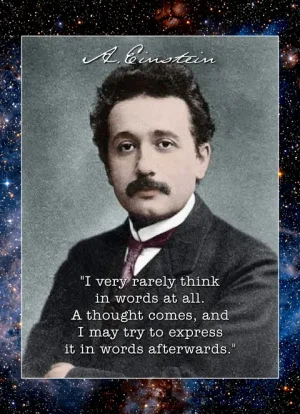
How many people can meditate or pray without their mind wandering down a rabbit hole? Try it for ten minutes with a timer set to stop. Our minds focus on thoughts a lot and without training the mind wanders. I must question the Einstein quote, because seeing something first could be a form of visual understanding. Yes, we display what we see into words to share what we see. However, I question the ability to understand without thoughts which display themselves in words, sometimes unspoken but there.

Creation of things make us like unto a founder. Creation has a lot to do with thoughts. We may find it a lengthy task to create something that is in our minds. Why? I would say because we constantly want to build or form it the best we can, making changes as we see the structure and fill it. We have time to think years ahead and add to it as we go. We can see something, then say to ourselves "I understand"; but when we understand something it may be through mental cognition using silent words. We all must have a way to express, and this is what I gained with his quote. I also think many synapses occur silently and we attribute it to no words, but we communicate in words a lot.

Memory is affected by so many different causes, but please remember age. I really question the loss of partial memory's causes. As we age, we are most likely on medications. However, they are what a doctor knows we need to keep our results on bloodwork in a specific level. They want you to go to a psychiatrist to get special need drugs. Drugs and more drugs they all must prescribe to coexist with other drugs, but they can cause different results. I am a lot like you, @meowzician , when not medicated. I rather like the feeling as opposed to being on drugs, but I get so little sleep I am depriving my body of rest I need to maintain my execution of thoughts. When my eyes start showing the lack of sleep, it is time to go back on the drugs. I don't recommend anyone doing this experiment, but I experimented with it. I wish there was a happy medium. Being on sleep medication slows my brain down, being part of my body. If I cut three pills to two pills daily at night, I am vibrant with little to no will to sleep. To sleep, I have to go back to three.

What is your focal point in the big picture, @Fruiteloop ? I am curious. It changes with time, doesn't it?
 
Last edited:
What is your focal point in the big picture, @Fruiteloop ? I am curious. It changes with time, doesn't it?

It depends on the type of memory we use to create new things.

A person can study a topic extensively and become an expert in that topic but then there is also transfer learning where being an expert helps us learn new topics faster. The more information we have the more we can relate them to eachother.

I am very good at manipulating data in certain ways inside a java program. Not the way you need to be able to open files and get the information but just as a general sense of data manipulation is how I know what to do. It became clear what to do afterwards. That would be called procedural memory in my case. But to a different extent. I have not opened any files or manipulated any data but I get the gist. What still confuses me are compilers and kernel. Those be more machine code based. Object-Oriented Programming (OOP) I now understand but not at the machine code level. I got hints but not yet.
 
I am a lot like you, @meowzician , when not medicated. I rather like the feeling as opposed to being on drugs, but I get so little sleep I am depriving my body of rest I need to maintain my execution of thoughts.
Sleep is every bit as important as food and exercise. Deprive a person of sleep and they cannot think straight, even if they think they can.

For me, sleep deprivation will lead directly to a depression that is life threatening.

If you need medication to fall asleep, then thank God for medical science. I take 50 mg of trazodone and a magnesium gummy vitamin.
 
I took four trazadone, tried cutting to three for a few weeks, then cut to two for a good while. One clonazepam in the middle of the day, which I cut to a half. My critical thinking was like on steroids. I started two books, created a living Trust, created an inner and outer LLC, and was feeling great. Fatigue finally knocked on my red eyes. I'm back on the clonazepam and three tramadol for a little while. I am still getting up before I get adequate rest and may eventually go back to four after I chat with my doctor again. I also have to take two pills at night for RLS. I don't feel dopey, but my big beautiful brain has slowed down again and I do miss it.

I took my wife and a friend's daughter to college with me to take Java. Everything went fine for about a week, then this old man couldn't keep up with college-level speed; I could have a few weeks ago maybe.
 
Last edited:
I get amazed with animals, fish, birds, and the likes....nature. Their tiny little brains must function similarly a bit like our own. I found my love working with specific German Shepherds. I taught one who was having problems staying while food was in front of them. This tested me, so I taught that dog to turn his head and look the other way. When they heard the command they went and ate the treat. I beat on the large plastic cup I feed the birds and squirrels with after putting their feed out. Always the same sequence: bump bump bump babump bump pause bump bump bump babump stop. They are relating the sound to feeding time now. I have learned with certain dogs: the nose knows.

Just hate to have the need to slow down.
 
Back
Top